

Today, we're releasing the public alpha of Tiles, our first step toward a privacy-first AI assistant built to run entirely on the user's device. Tiles brings together local-first models, personalized experiences, and verifiable privacy guarantees, so data remains under the user's control by default. We see identity and memory as inseparable parts of the same system, and Tiles is designed around that idea: an AI assistant that acts as a user-owned agent rather than a centralized service.
Our first alpha is a CLI assistant app for Apple Silicon devices, and a Modelfile1 based SDK that lets developers customize local models and agent experiences within Tiles. We aim to evolve Modelfile in collaboration with the community, establishing it as the standard for model customization.
Philosophy
The project is defined by four interdependent design choices:2
- Device-anchored identity with keyless ops: Clients are provisioned through the device keychain and cannot access the registry by identity alone.3Keyless operations are only enabled after an identity is verified and linked to the device key, allowing third-party agent access under user-defined policies.
- Immutable model builds: Every build is version-locked and reproducible, ensuring consistency and reliability across updates and platforms.
- Content-hashed model layers: Models are stored and referenced by cryptographic hashes of their layers, guaranteeing integrity and enabling efficient deduplication and sharing.
- Verifiable transparency and attestations: Every signing and build event is logged in an append-only transparency log, producing cryptographic attestations that can be independently verified. This ensures accountability, prevents hidden modifications, and provides an auditable history of model provenance across devices and registries.
Implementation
Our goal with Tiles is to co-design fine-tuned models and the underlying ML infrastructure to maximize efficiency for local and offline inference and training.
We support gpt-oss-20b and provide an opinionated package of prompts, tools, and on-device models optimized for your hardware. Tiles also includes a built-in code interpreter for executing Python functions. We use venvstacks, layered Python virtual environments, to keep Tiles isolated from system dependencies and portable across platforms.
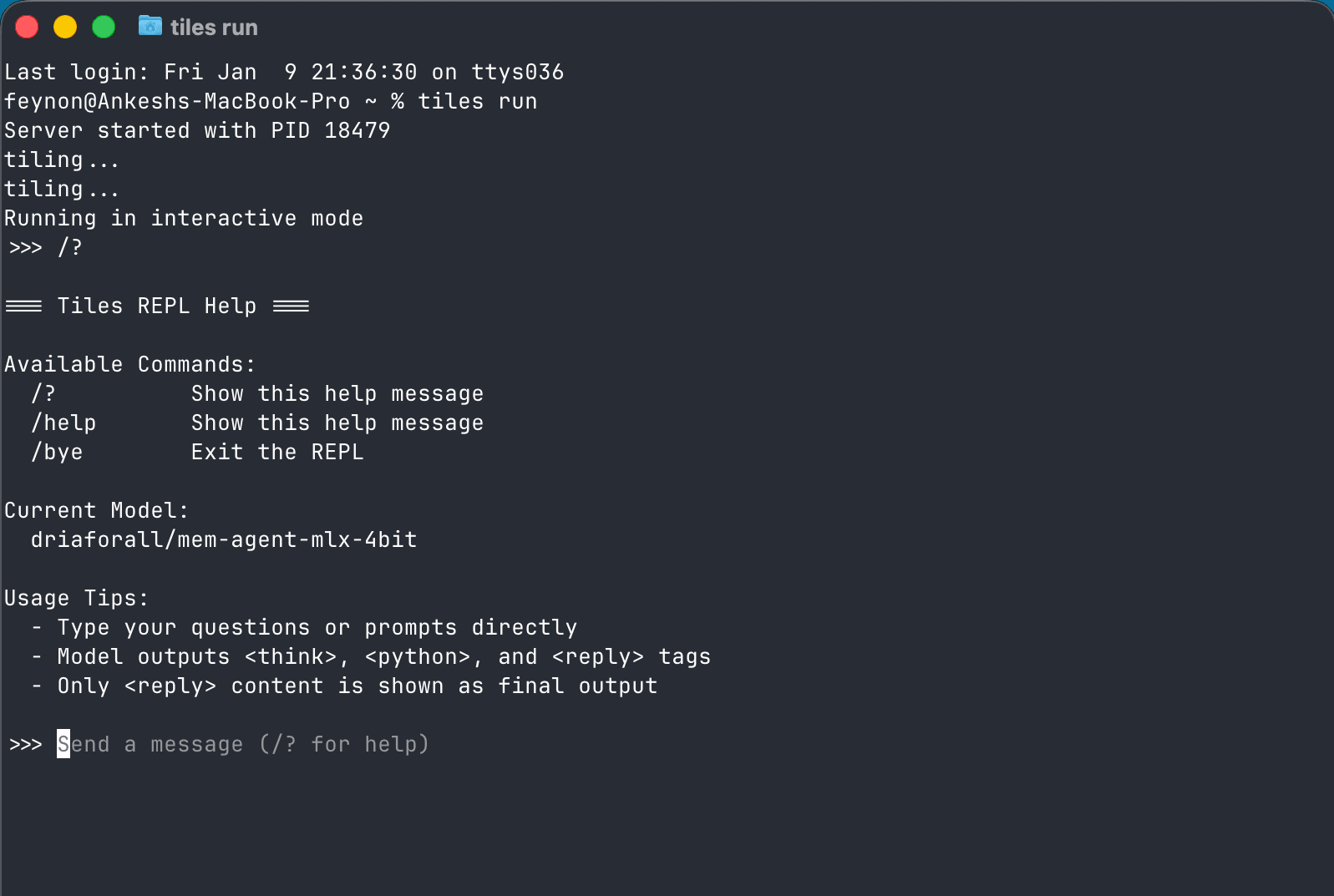
We are also working toward memory capabilities powered by fine tuned models that manage context and memory locally on device using hyperlinked Markdown files. This is currently behind an experimental flag. We use the mem agent model from Dria, based on qwen3-4B-thinking-2507, and are in the process of training our initial in house memory model.
These models utilize a human-readable external memory stored as markdown, and learned policies (trained via reinforcement learning on synthetically generated data) to decide when to call Python functions that retrieve, update, or clarify memory, allowing the assistant to maintain and refine persistent knowledge across sessions.
Looking forward
We're building the next layer of private personalization: customizable memory, private sync, verifiable identity, and a more open model ecosystem.
- Memory extensions: Add support for LoRA-based memory extensions so individuals and organizations can bring their own data and shape the assistant's behavior and tone on top of the base memory model.
- Sync: Build a reliable, peer-to-peer sync layer using Iroh for private, device-to-device state sharing.
- Identity: Ship a portable identity system using AT Protocol DIDs, designed for device-anchored trust.
- MIR in Modelfile: Work with the Darkshapes team to support the MIR (Machine Intelligence Resource) naming scheme in our Modelfile implementation.
- Registry: Continue supporting Hugging Face, while designing a decentralized registry for versioned, composable model layers using the open-source xet-core client tech.
- Research roadmap: As part of our research on private software personalization infrastructure, we are investigating sparse memory finetuning, text diffusion models, Trusted Execution Environments (TEEs), and Per-Layer Embeddings (PLE) with offloading to flash storage.
We are seeking design partners for training workloads that align with our goal of ensuring a verifiable privacy perimeter. If you're interested, please reach out to us at hello@tiles.run.